"Amusing Trial in which a Yankee Lawyer Renders a Just Verdict" by Anonymous is a thought-provoking poem set in early 19th-century America. The poem tackles the difficult issue of slavery, using the story of a slave named Cuff and his lawyer master to explore themes of justice, freedom, and moral responsibility. Cuff, despite being well-cared for, yearns for liberty and runs away, leading his master to confront the ethics of his own actions. During the pursuit, the lawyer questions the very foundation of slavery. This internal conflict leads him to a powerful decision: he chooses to release Cuff, acknowledging the universal right to freedom and highlighting the importance of justice and human dignity over ownership, pushing readers to consider the true meaning of liberty and equality.

Amusing Trial in which a Yankee Lawyer Renders a Just Verdict
By Anonymous
A slave's daring escape forces his master to confront his conscience and choose between ownership and the undeniable right to freedom.
Summary
About the AuthorAnonymous works are works, such as art or literature, that have an anonymous, undisclosed, or unknown creator or author. In the case of very old works, the author's name may simply be lost over the course of history and time. There are a number of reasons anonymous works arise.
Anonymous works are works, such as art or literature, that have an anonymous, undisclosed, or unknown creator or author. In the case of very old works, the author's name may simply be lost over the course of history and time. There are a number of reasons anonymous works arise.
More Like This
Explore books similar to the one you're viewing
The Anti-slavery Harp: A Collection of Songs for Anti-slavery Meetings
By William Wells Brown
The Trial of Reuben Crandall, M.D. Charged with Publishing and Circulating Seditious and Incendiary Papers, &c. in the District of Columbia, with the Intent of Exciting Servile Insurrection. Carefully Reported, and Compiled from the Written Statements of the Court and the Counsel.
By Unknown
A History of the Trial of Castner Hanway and Others, for Treason, at Philadelphia in November, 1851 With an Introduction upon the History of the Slave Question
By Member of the Philadelphia bar
Poems on Slavery
By Henry Wadsworth Longfellow
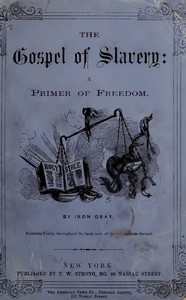
The Gospel of Slavery: A Primer of Freedom
By Abel C. (Abel Charles) Thomas
Speech of John Hossack, Convicted of a Violation of the Fugitive Slave Law Before Judge Drummond, Of The United States District Court, Chicago, Ill.
By John Hossack
Anti-Slavery Poems 1. Part 1 From Volume III of The Works of John Greenleaf Whittier
By John Greenleaf Whittier
More by This Author
Discover other books written by the same author

The Curtezan unmasked; or, The Whoredomes of Jezebel Painted to the Life With Antidotes against them, or Heavenly Julips to cool Men in the Fever of Lust.
By Anonymous
Biographical Outlines: British History
By Anonymous
Manners and Rules of Good Society; or, Solecisms to be Avoided
By Anonymous
Easy to Make Fashions: from Rochelle's Mohlon Orlon Acrylic Fiber. Volume B22.
By Anonymous
The World English Bible (WEB): Colossians
By Anonymous
The Alberta Public School Speller Authorized by the Minister of Education for Alberta
By Anonymous
Related by Category
Discover books in the same genre or category
A Traveler from Altruria: Romance
By William Dean Howells
The Vicar's People
By George Manville Fenn
Harper's New Monthly Magazine, No. XXVII, August 1852, Vol. V
By Various
The Past and the Present Condition, and the Destiny, of the Colored Race: A Discourse Delivered at the Fifteenth Anniversary of the Female Benevolent Society of Troy, N. Y., Feb. 14, 1848
By Henry Highland Garnet
The International Jewish Cook Book 1600 Recipes According to the Jewish Dietary Laws with the Rules for Kashering; the Favorite Recipes of America, Austria, Germany, Russia, France, Poland, Roumania, Etc., Etc.
By Florence Kreisler Greenbaum
Observations Upon the Windward Coast of Africa The religion, character, customs, &c. of the natives; with a system upon which they may be civilized, and a knowledge attained of the interior of this extraordinary quarter of the globe; and upon the natural and commercial resources of the country; made in the years 1805 and 1806; with an appendix, containing a letter to Lord Howick, on the most simple and effectual means of abolishing the slave trade
By Joseph Corry
Account Required
You need an account to complete this action.